This is a continuation of the Alternative Deliveries post, about the still-forming landscape of art and digital distribution. One word you’ll sometimes hear when talking about art and digital technologies is democratization. The idea is that the power is shifting from being centralized in museums, publishers, film studios, and other presenters to being shared with savvy individual artists who get the stuff out there themselves.
Panacea! Or wait. Are there potentially major drawbacks and even a measure of stigma attached to the whole self-presented model? Short answer: well, yeah. Except when there isn’t.
There’s self-presentation as a promotional tool, and then there’s self-presentation as the “best and most appropriate way to get this awesomeness out into the cosmos.” By promotional tool, I mean teasing material on a website to promote sales, or those stories you hear about artists who present their work in nontraditional ways (self-published books, music on Myspace, streamed films) that have then segued into traditional presentations like a commercial publisher or music label. All well and good – why not nudge things forward a bit? But then there are those artists who’ve decided that the best way to get their work out into the great wide world is to present it themselves. And the kicker is that sometimes, some rare, sublime times, they’re right. DIY is in fact the best way for them to D.
Presenters are gatekeepers, and one good thing about gatekeepers is they force tough scrutiny of one’s work. One way that artists can present their own work without forgoing the peer scrutiny is by forming artist-run organizations. In Massachusetts, we have groups like Boston Sculptors Gallery or Mobius who provide space and support structures for presenting their members. Nationally, there are groups like 13P, a consortium of 13 cutting-edge playwrights whose mission is to present its members’ work. When not the produced playwright, members pitch in on the current show. The group is widely praised in the theater community, but as much as everyone loves the concept, if the playwrights (including MacArthur Genius Grant recipient Sarah Ruhl) weren’t as intriguing as 13P’s are, the concept wouldn’t work.
Digital technologies offer some new avenues for presenting one’s work, with ready-made communities to scrutinize, respond, and even collaborate. I recently read an article about singer-songwriter Jonathan Coulton, who’s done quite well for himself offering his geek-themed songs on his website. He chose to share some material through a Creative Commons license, encouraging fans to actually create and post music videos featuring his songs. Again, the concept is great, but it works mainly because the art does, the ideal delivery of the ideal work to the ideal community.
When you present your own work, some potential risks are avoided, like rejection by a presenter or having your work compromised or botched by others. But there are new layers of risk, not the least of which being the stigma I mentioned above. (What’s the matter, no presenter would take you?) Another, even greater risk: that you’ll miss out on the benefits that an engaged, collaborative presenter will bring to your project.
New technologies aside, I’d hazard to say most artists would still prefer their work to see the benefits of collaborative, supportive presenters. But the good news is that those intriguing projects whose content is best shared DIY may be just a bit easier to accomplish, as the digital march continues.
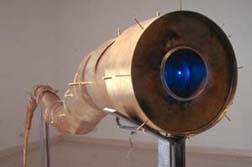
Image: Deb Todd Wheeler, detail from LUDICRUM: NATURALIA, ARTIFICIALIA, SCIENTIFICA V.5 (2002), brass, steel, LCD screen, video, 78 in. x 28 in. x 60 in.
Leave a Reply