
Please note: the Artist Fellowships Program is on pause this grant cycle (Fiscal Year 2023).
In the Mass Cultural Council Artist Fellowship Program, we instruct our panelists to make their grants decisions based on two criteria*:
- Artistic quality
- Creative ability
Given that all decisions are based solely on your art, you might conclude that the best advice might be, as Neil Gaiman put it in a commencement address at the University of the Arts, “Make good art.”
This is a good a point. Do make good art. But we thought we’d share some ideas on optimizing your application, which really means avoiding choices that might distract panelists from how well you’ve adhered to Mr. Gaiman’s advice.
(We’re not even going to mention that you should carefully read – and follow – the guidelines, and that you should familiarize yourself with the guidelines and instructions ahead of time, so you’re not rushing on the evening of the deadline.)
Which work samples should I submit?
Since the work sample(s) you submit are the only evidence the panelists will have to understand you as an artist, what you decide to include is an important choice. That said, don’t overthink it. Rather than trying to guess the judges’ tastes, just send your strongest work. Truly. Individual panelists have stylistic preferences, but you can expect arts professionals working at a high level to be able to recognize great work in a style not their own.
How do you know what’s your “strongest” work? If you have any question, enlist the opinion of a trusted peer, whose objective distance can be helpful.
We ask for recent work (past four years), but it doesn’t necessarily have to be your brand-spankin’-newest. You might be most excited about your newest work, but is it your strongest? (And maybe it is! Here’s where the opinion of a trusted peer might be useful.) What if you want to send the same work you sent the last time you applied – work that didn’t win you a fellowship? If you still consider it your strongest, send it again. The panelists change every cycle, and plenty of times, we’ve seen work that was passed over one cycle be successful the next.
One question we often get is whether it’s better to send a group of excerpts from different work (to show range) or a longer section of just one. In visual arts, the equivalent might be five images from different series vs. five from the same series.
Illustrating your range as an artist can be helpful, but in your hierarchy of considerations, “showing range” should come second to “giving the panelists a great artistic experience.” Ideally, your sample will compel the panelists as it would any audience, while conveying your unique voice as an artist. Successful applicants tend to excel at demonstrating a cohesive vision – with room for variety.
Start strong. The beginning of your sample – first image, first pages, first few minutes – makes an impression that impacts the entire experience. Also, if you’re sending an excerpt of a longer work, send a meaty part. If the portion you send is all set-up, the panelists might say, “Well, it’s good craft, but how do I know this artist can effectively develop this?”
(Further research: the Creative Capital blog has some great tips on choosing your work sample. While some of the advice is tailored for that organization’s grant application, much of it could apply to any artist grant.)
Preparing Your Work
Please note that for visual arts disciplines (Crafts, Drawing & Printmaking, Painting, Photography, and Sculpture/Installation/New Genres), you’ll need digital versions of your art to upload. For tips on photographing your art, check out Saatchi Online’s easy-to-follow tutorial video.
In disciplines that ask for pages: readability is your friend. Avoid diminishing margins and fonts just to fit more in. More is not better.
If your work is interactive, conceptual, or time/performance-based, think hard about how to best convey your intended art experience in a compressed format and timeframe. Obviously a short video of or five images from your work won’t capture the whole, in-person experience. But think of the audience member watching your work on-stage or walking through your installation – what’s the best way to recreate their experience, or something close to it, for (say) a panelist sitting at their laptop?
(Further research: read ArtSake’s post on documenting your work.)
Work Sample Description
In all categories, applicants have the opportunity to include a brief work sample description to give, if necessary, context to the submitted sample(s). We believe the Work Sample Descriptions can be useful. But sometimes panelists complain that descriptions are distracting when they read like self-promotional marketing copy, or when they spell out themes or emotional responses that should be implicit in the art experience.
Well then what is Mass Cultural Council looking for with this Work Sample Description? As one panelist put it, the Work Sample Description should invite us into the world of the work. Put yourself in the panelists’ shoes: sitting in a meeting (or virtual) room, reading a sample or experiencing your work projected or played. Things that would be obvious in a book or a gallery or a performance venue may not be obvious in that context. Any time panelists spend wondering how they’re “supposed” to be experiencing your work is time they’re not discussing its good qualities. Even details that seem self-evident to you – for instance, whether your work is a full piece or an excerpt from something longer – may not be clear to someone approaching your work without context.
Beyond that? Be brief, including only enough information to allow reviewers to understand the piece. And if your work needs no explanation, don’t feel you need to fill in the box. No description is fine, if none is needed!
The X factor
There’s always a touch of mystery to what makes a particular work click with a particular audience. It’s a given that the level of artistic quality should be high, but what makes a juror (or any audience) love love LOVE it? To some extent, it’s an X factor, out of your control. So we’d suggest you control what you can, avoid distracting application choices, and continue to do your great work.
And email us or add a comment below if you have a question not covered here.
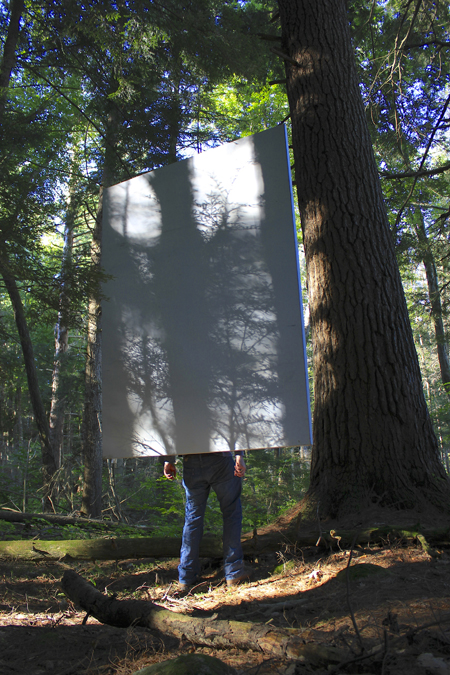
Image and media: Stephanie Chubbuck (Crafts Fellow ’15), TWO (2013), blown and coldworked ruby glass, forged copper, mixed media, 18x14x7 in; video documentation of SPIRALING WATER by Georgie Friedman (Sculpture/Installation/New Genres Fellow ’13); Samuel Rowlett (Sculpture/Installation/New Genres Fellow ’15), LANDSCAPE PAINTING IN THE EXPANDED FIELD, canvas, oil, wood, backpack, harness, a walk in the woods, 12x6x2 ft.
* Except in the case of Traditional Arts, which has additional criteria.
Anthony Raffaele says
I will submit my visual arts disciplines as a sculpture of a six foot six inch tall Christmas tree with 17 life like actual size red lobsters that are all hand crafted solid wood lob that sized accordingly in a pyramid like fashion from the base of the tree graduating to the top of the nautical theme,
Blake says
Perfect! I would only suggest that you offer single editions of the solid wood lobs in the gift shop at an approchable price. Say, $200 – $300. Those little wood lobs will always remind the buyer of your art, and who knows which of them may add you to their will as the sole inheritor of their entire multi-billion dollar estate!
Loren Miner says
Very helpful?thank you?
Virginia Sandman says
“Naming and uploading your work samples: The title of your first work sample will be the “name” used to identify your application. Please name each file with the title of the corresponding work sample.”
This is a bit confusing. If the first title is: “Blue ocean”, and the next title is: “Dark Sky” the next “Waves.” does that mean that the titles go like this:
Blue Ocean
Blue Ocean Dark Sky
Blue Ocean Waves
ArtSake says
Thanks. What we mean is that instead of calling your application by your name (because this is an anonymous review), we’ll refer to your application as (to use your example) “Blue ocean” – the first Work Sample title you give us.
Emily says
Are you allowed to submit applications in more than one fellowship area?
ArtSake says
Yes, you may submit applications in more than one Artist Fellowships category. However, you need to submit different work for each application, and you can only apply once per category (in other words, you could submit applications in Choreography and Poetry, but you could not submit two applications in Choreography). Find more here: https://massculturalcouncil.org/artists-art/artist-fellowships/application-process/
Lisa says
Is it better to show images cropped tight to the painting edges vs showing walls or painting in a context?
ArtSake says
Thank you. We’d suggest cropping the photo to the painting’s edges.
Lisa says
Is there a place where we can see applications of prior winners?
ArtSake says
You can see samples of past awardees’ work (which most often is the same work artists submitted in their applications) in our online Gallery: https://massculturalcouncil.org/artists-art/gallery/
Stephen Remick says
Will the panelists be able to read the “description” entry that is included with each individual work with the title, medium, size, and date, in addition to the “work sample description”?
ArtSake says
Yes, review panelists will see the individual descriptions, as well as the optional Work Sample Description. Thanks!
Amy says
If I received COVID-19 Relief Funds, am I still eligible for this round of grants, or does that cancel me out?
Thank you.
ArtSake says
Hi, receiving a COVID-19 Relief Fund for Individuals grant in 2021 or 2020 does NOT block you from applying for an Artist Fellowship. As long as you meet the other eligibility requirements, you are eligible to apply for an Artist Fellowship.