Lisa Nilsson‘s Tissue Series, currently on exhibit at the Lavender Door Gallery in Stockbridge, depicts anatomical cross sections, created from rolled paper.
How did she come to make this work, this way? We asked the artist for a look into her work space, and into the history and process behind this enthralling series.
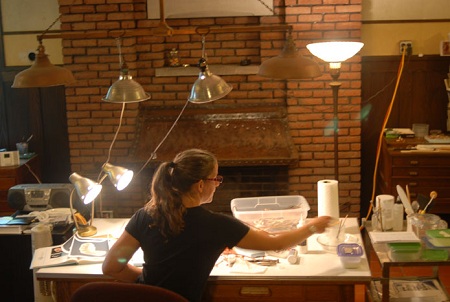
I was out “junking” and came across an antique quilled piece of religious art. It was a very fancy filigreed crucifix-gilt. I later learned that nuns and monks used edges of old bibles to make pieces like this. I incorporated the technique into some assemblages I had been making that contained many different found and made elements. Around this time I encountered a French hand-colored print of an anatomical cross section. I loved the colors and shapes and felt that the way paper behaves when rolled and shaped in quilling could work very well in representing what I saw in the anatomical print.
I started creating anatomical cross sections made of Japanese mulberry paper and the gilded edges of old books, using that same quilling (or paper filigree) technique.
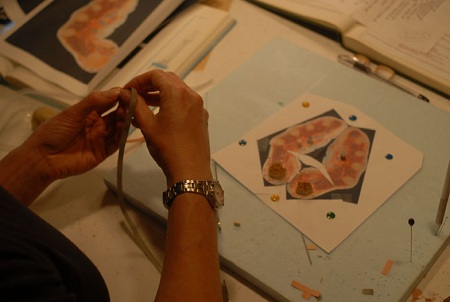
Here I’m just getting started on a new piece. I build the work over an image or drawing, pinning parts to a piece of Styrofoam insulation (probably the single most useful and versatile material in my studio). I tend to work from the center out. When the piece is finished, I turn it over and brush the back with PVA (the white glue that book makers use) and the piece takes on enough strength and rigidity to hold its shape without pins.
I like to have several sources of reference material for each piece so that I can pick and choose elements from each that work to the piece’s advantage, and I can more fully understand what I am looking at.

This piece represents a cross section of hands in prayer position. The section passes through laterally at the level of the metacarpals (the bones of the main part of the hand).
I’ve partially made the bones of the thumb knuckles and some tendons.

This part of my studio was originally the laundry room, and is where I make the boxes that contain my pieces. I make them out of cherry wood and old glass and cover the outside with Japanese silk book cloth. It is beautiful stuff to work with. I’ve had the good fortune to have friends in the book arts that have taught me good paper and paste technique. It’s fussy, precise, clean work that I enjoy in a certain state of mind.

This piece represents a lateral section through the head at about nose level. It is life-size. I love how asymmetrical the body looks in cross section. We are so symmetrical on the outside and so asymmetrical on the inside and everything inside fits so perfectly. This is the connection I made to quilling. Rolled pieces of paper are amenable to being squeezed, shaped and shifted to fill a space. I use mulberry paper for its fabric-like strength and flexibility and the sophisticated color palette it is available in.

This piece represents a midsagittal section (the one that cuts through the center making a left half and a right half) of the head and chest. I employ a device of making all of the bones in my work from the gilded edges of old books. I do this for aesthetic reasons as well as a means of pulling the pieces away from the world of scientific specimens and a bit more in the direction of religious reliquaries. I like to emphasize the reverential and the precious; to have a look inside is such a privilege.

I continually challenge myself to increase my vocabulary of quilling shapes and textures while sticking to the inherent grammar of the technique. It is important to me that the viewer’s eye does not grow weary of looking at swirls.

I like for my works to read more as objects than as images. To that end, I show the lateral sections lying flat on shelves and the vertical ones, standing upright in an altarpiece-like fashion.
Lisa Nilsson’s Tissue Series: Anatomical Cross Sections in Paper will be on exhibit at the Lavender Door Gallery (37 Main Street, Stockbridge, MA), through August 24, 2011.
Lisa Nilsson is a graduate of the Rhode Island School of Design where she studied Illustration, and more recently of the McCann Technical School’s medical assisting program, where her life-long aesthetic interest in anatomy and cool-looking medical things grew a bit more informed. She lives in North Adams, Massachusetts.
All images courtesy of Lisa Nilsson.
Sarah Yakawonis says
I started doing work like this about a year before Lisa did. . .
http://yakawonis.blogspot.com/2010/12/quilled-brain.html
Charli says
I have been quilling for over 50 years. Your quilling is outstanding and shows just how versatile quilling is.
This is why I stress practice, practice, practice when I teach quilling.
Farah says
i started quilling in 2004 and tried different styles never seen quilled artwork with that level of details .. i loved it
Chris Mainwaring says
you should do an optical illusion with one it would look so cool, this is really good work.